Montclair's residential landscape is characterized by prominent hillside topography along the First Watchung Mountain, dense clay soil layers, and deep stone or poured concrete foundations. When moisture manifests on a cellar floor or behind finished basement wall paneling, property owners often assume heavy rainfall is the only culprit. However, pressurized domestic supply lines, overhead waste pipes, hydronic boiler loops, and water heater assemblies frequently fail in cellar spaces. Using non-invasive diagnostics for leak detection in Montclair eliminates guesswork before you invest thousands in unnecessary french drains or waterproof coatings.
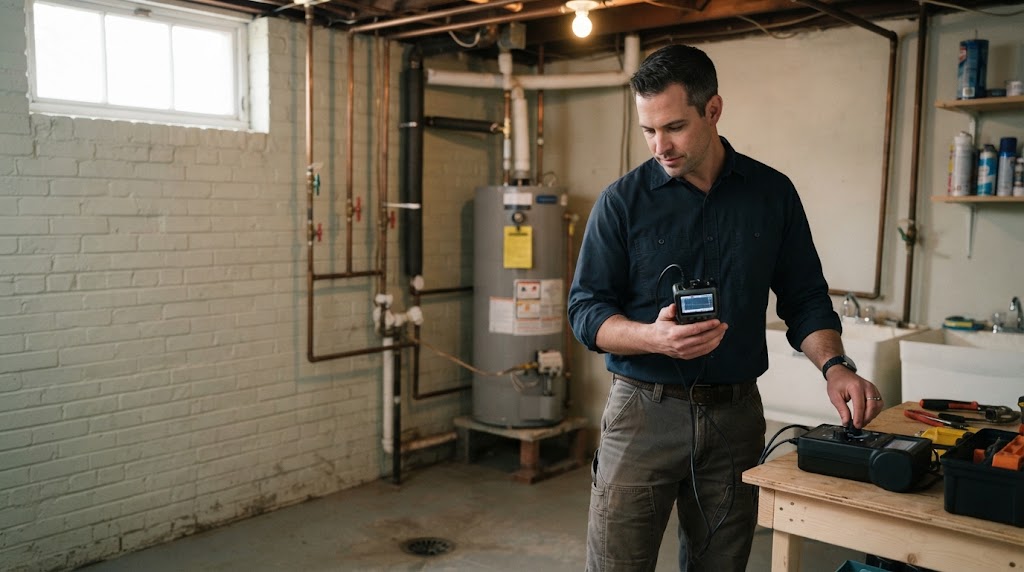
Plumbing Leak vs. Groundwater: Answering the Critical Question
Determining whether you are dealing with a water in basement plumbing leak Montclair situation or soil groundwater requires clear scientific diagnostics. Groundwater infiltration typically tracks with seasonal downpours, hurricane remnants, or spring snowmelt, entering through foundation cold joints or settling fissures.
In contrast, a domestic plumbing leak continues constantly 24 hours a day, regardless of dry summer heat or freezing winter weather. A pressurized supply line or cracked drain branch concealed behind finished drywall will continually soak subflooring, saturate bottom plates, and cause ongoing mold growth. Our diagnostic protocol performs systematic pressure isolation tests and chemical residual checks to conclusively confirm if pooled water contains municipal chlorine or untreated groundwater.
Warning Signs of Concealed Basement Plumbing Leaks
Because many basements in Montclair have been finished into family rooms, home offices, and guest suites, plumbing failures frequently hide behind insulation and drywall:
- Persistent Wet Basement Odors: A constant wet basement leak Montclair homeowners notice through persistent musty smells or active dampness along perimeter baseboards.
- Spongy Carpet or Warped Vinyl Planks: Moisture pooling under floating subfloors or carpet padding when a concealed basement pipe leak Montclair line develops a pinhole fissure.
- Efflorescence and Peeling Paint on Foundation Masonry: White mineral crusts forming along basement walls, signaling that pressurized moisture is forcing salts through masonry pores.
- Continuous Sump Pump Cycling in Dry Weather: Sump pumps running repeatedly when no rainfall has occurred, often triggered by a leaking main water service line entering beneath the foundation.
- Water Heater Base Rust & Staining: Moisture weeping from internal tank linings or corroded relief valves, collecting quietly in boiler room floor trenches.
Local Montclair Housing and Geological Factors
The varying elevations between Upper Montclair estates near Eagle Rock Reservation and the lower elevations near Montclair Center and Walnut Street create significant hydraulic variation. Older homes frequently feature fieldstone foundations with mortar joints that are vulnerable to both external soil pressure and internal pipe vibration. When domestic copper piping was installed through these foundation walls decades ago, contact with masonry mortar often initiated galvanic corrosion. Differentiating external runoff from internal pipe degradation requires precision testing tailored to Montclair's unique construction history.
Water Pooling in Your Finished Montclair Basement?
Do not tear down your finished walls before knowing the true cause. Call our diagnostic specialists to inspect the water source.
Step-by-Step Diagnostic Protocol for Basement Leaks
We follow a structured investigative workflow to uncover the exact source of cellar moisture:
- Municipal Supply Chlorine & Pressure Verification: We perform chemical chlorine test strips on pooled water to confirm municipal water presence and conduct static pressure tests to verify if the domestic supply system holds pressure.
- Acoustic Sub-Slab Listening: High-gain ground microphones listen through concrete slabs for the high-frequency hiss of pressurized water escaping from buried supply piping or hydronic heating lines.
- Thermal Boundary Mapping: High-resolution infrared cameras scan ceiling joists, wall bases, and floor slabs, pinpointing the cool evaporation boundaries or hot water trails created by active leaks.
- Drain and Waste Line Dye Testing: Non-staining fluorescent dyes are introduced into upstairs shower drains, washing machine traps, and toilets to determine if basement moisture is originating from cracked vertical waste stacks.
- Sump and Floor Drain Integrity Inspection: We examine discharge check valves, sump basin seals, and sub-slab drain connections to ensure waste water is not leaking back into foundation gravel beds.
What Happens After Detection: Repair Options
Once our non-invasive tests isolate the failure, property owners receive actionable diagnostic findings. If the issue is a pressurized pipe breach, a licensed master plumber can open a minimal 6-inch inspection window rather than demolishing an entire wall. Technicians can replace corroded copper sections, repair failed solder joints, or install a modern PEX bypass. If an overhead drain stack or bathroom connection is at fault, our pipe leak repair and sewer line leak detection services ensure the precise drain section is targeted.
Cost Factors in Basement Leak Diagnostics
The scope and technical effort required for basement leak detection depend on several property-specific variables:
- Level of Basement Finishing: Open unfinished utility cellars allow rapid direct inspection, whereas fully finished basements with framed walls, spray foam insulation, and drop ceilings require specialized thermal and acoustic mapping.
- Hydronic Radiant Heating Systems: Homes with hot water radiant loops embedded directly in concrete slabs require thermal imaging during active boiler heating cycles.
- Depth of Sub-Slab Utilities: Pressurized lines buried deep beneath structural concrete footings require acoustic frequency filters to isolate against ambient building noise.
- Multiple Intersecting Symptoms: Scenarios involving simultaneous foundation weeping and slow plumbing leaks require multi-stage chemical and pressure testing.
Basement Moisture Prevention Tips
Take proactive steps to safeguard your Montclair basement from recurring plumbing failures:
- Maintain proper clearance around boiler and water heater relief discharge lines; verify that drain pans and spill lines route directly to open floor drains.
- Insulate cold domestic water supply pipes in humid basement environments to prevent condensation dripping that mimics an active pipe leak.
- Test your sump pump float switch and battery backup system every six months, especially prior to major storm events.
- Schedule routine acoustic surveys if your home has copper plumbing installed prior to 1980 beneath basement concrete slabs.
When Does Basement Moisture Become an Emergency?
While slow perimeter seepage allows for scheduled evaluation, certain situations demand immediate emergency response:
If water is rising rapidly across a basement floor, approaching electrical outlets, hot water heaters, or furnace burners, there is an immediate risk of electrical shock and equipment damage. Shut off your main water valve immediately, turn off power to the basement circuit at the main breaker if safely accessible from dry ground, and review our emergency leak repair guidance.
Montclair Neighborhoods Prone to Basement Leaks
Basement moisture issues frequently impact homes along the steep elevations of Upper Montclair near Eagle Rock Reservation, where groundwater pressure frequently masks underlying plumbing leaks. Similar challenges occur in historic properties near Watchung Plaza and the Walnut Street district, where century-old sewer stacks and water heater lines hidden inside finished utility rooms experience age-related fatigue.
Frequently Asked Questions About Basement Leak Detection
How can I tell if water pooling in my basement is from plumbing or groundwater seepage?
Plumbing leaks occur constantly, independent of weather, and cause continuous meter dial movement or pressure drops. Groundwater seepage correlates directly with regional rainfall, heavy snowmelt, or high water tables, and water meter dials remain stationary when fixtures are idle.
Can you test for leaks behind finished basement drywall without tearing down framing?
Yes. We utilize infrared thermographic cameras, acoustic contact listening probes, and radio-frequency moisture meters to scan behind drywall and under baseboards, pinpointing saturated insulation or leaking pipes without exploratory cutting.
Why do water heaters leak from the base in older basements?
Internal tank corrosion from hard mineral buildup or a failing temperature and pressure (T&P) relief valve discharge pipe often creates pooling at the base. Our technicians test tank fittings, valves, and cold water supply lines to verify the exact source.
Are basement floor drain backups considered plumbing leaks?
Yes. A backing-up floor drain typically points to a blockage or breach in the sub-slab drain tile or sanitary sewer lateral, which can be verified using specialized video pipe inspection cameras.
Stop Guessing About Your Montclair Basement Water Problem
Determine the true source of your basement moisture before opening walls. Call our diagnostic specialists today.