In Montclair's vintage early-twentieth-century homes, domestic water lines were routed through complex framing networks, tucked behind thick plaster partitions, and buried beneath tongue-and-groove quarter-sawn oak flooring. When a pressurized line develops a breach, the water does not always present directly at the point of origin. It frequently travels along structural floor joists, dripping through light fixtures several rooms away or soaking insulation for weeks. Conducting non-invasive leak detection in Montclair allows homeowners to locate the precise source before costly exploratory demolition takes place.
Warning Signs of Concealed Structural Plumbing Leaks
Homeowners frequently notice secondary physical symptoms long before water visibly pools on finish surfaces. Recognizing these signs early prevents deep structural wood rot and costly restoration work:
- Unexplained High Water Bill: A sharp jump in utility charges or experiencing a high water bill leak Montclair NJ families notice when water continuously escapes into subflooring.
- Water Meter Movement: The leak detector triangle or low-flow digital indicator spins on your meter even when all toilets, laundry machines, and sinks are completely shut off.
- Discolored Ceilings and Swelling Drywall: Yellowish rings or softening plaster on ceilings beneath upper-level bathrooms indicating persistent moisture migration.
- Warm Spots on Finished Flooring: Localized heated sections on tile or wood floors indicating a hot water supply line rupture in a subfloor cavity.
- Musty Odors and Mold Spores: A lingering earthy scent in basements, vestibules, or finished hallways where stagnant water is trapped behind wall cavities.
Local Housing and Environmental Factors in Montclair
The architecture throughout Upper Montclair and Watchung Plaza commonly features legacy copper piping retrofitted into Victorian or colonial balloon framing. Decades of acidic water friction, solder joint fatigue, and winter freeze-thaw cycles create stress points at ninety-degree elbows and T-junctions. When seeking hidden water leak detection Montclair homeowners must contend with plaster walls that resist simple moisture meters. Plaster retains residual dampness differently than modern sheetrock, requiring calibrated electromagnetic frequency testing to accurately separate active pipe breaches from historic ambient humidity.
Suspecting a Leak Behind Wall Montclair Residence?
Do not let contractors tear down irreplaceable woodwork or plaster blindly. Let us locate the exact pipe failure first.
Step-by-Step Non-Invasive Detection Protocol
Our rigorous systematic diagnostic process isolates the exact failure point without tearing open finished surfaces:
- System Isolation & Pressure Decay Testing: We isolate the plumbing system into cold and hot domestic zones using precision pressure gauges. If pressure drops while all isolation valves are closed, a pressurized pipe breach is confirmed.
- Acoustic Frequency Listening: Pressurized water escaping through a fissure generates unique acoustic frequencies. Using ground microphones and contact sensors, we trace the sound signature through flooring and dense walls.
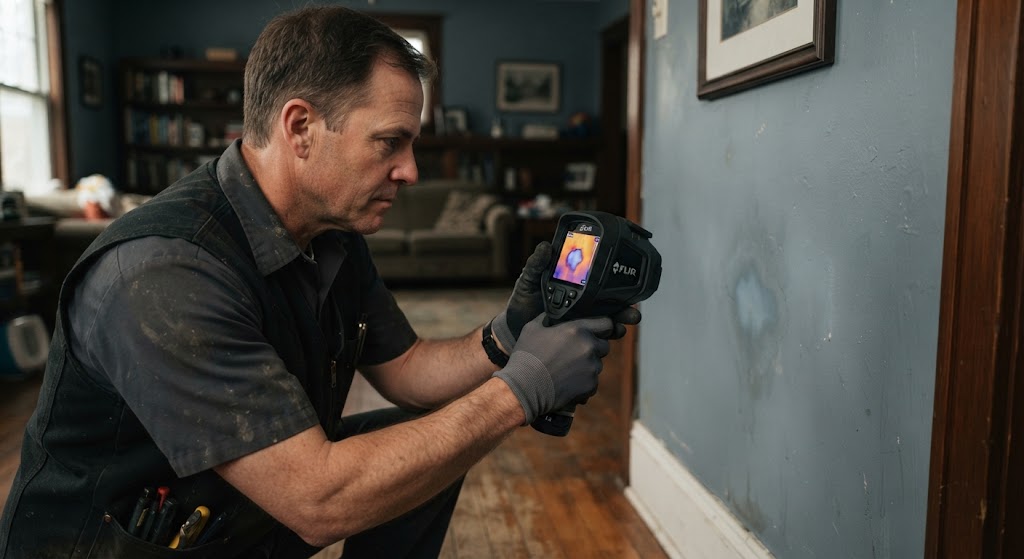
- High-Resolution Thermographic Scanning: Infrared thermal cameras measure temperature differentials across building materials, capturing thermal plumes created by escaping hot or cold water.
- Moisture Mapping & Dielectric Analysis: Non-penetrating radio-frequency moisture meters map the saturation boundary in plaster, hardwood, and baseboards to track the moisture plume back to its hydraulic source.
- Tracer Gas Pressurization (When Needed): For microscopic pinholes in deep chases or underground lines, an inert, non-toxic nitrogen-hydrogen tracer gas is introduced into the drained line and detected at the surface with sensitive sniffers.
What Happens After the Leak Is Found: Repair Options
Once our specialists mark the exact footprint of the leak, property owners receive an objective diagnostic report. Repair strategies can then be executed with minimal property disruption:
Depending on pipe condition and accessibility, a licensed plumber can perform a localized surgical cut-in to replace the damaged copper section, solder a new slip coupling, or install a modern PEX bypass. In cases where vintage piping shows systemic galvanic corrosion, technicians may recommend running an overhead PEX line rather than tearing up original hardwood floors. For exterior supply lines, you may also need water line leak detection to verify service lines outside the foundation.
Cost Factors in Diagnostic Leak Pinpointing
Diagnostic investment varies based on architectural complexity rather than arbitrary pricing. Key factors that influence the scope of non-invasive detection include:
- Structural Construction: Thick historic plaster over wire or wood lath requires more sophisticated multi-sensor testing than standard half-inch modern drywall.
- Depth & Material of Piping: Lines buried under finished hardwood parquet, ceramic tile beds, or structural masonry take additional acoustic tuning to isolate.
- Accessibility of Shut-Offs: Systems with working zone isolation valves allow faster diagnostic segmentation than older plumbing setups with corroded main valves.
- Number of Suspected Zones: Homes with complex multizone hydronic radiant floor heating or multi-story supply stacks require broader testing sequences.
Prevention Tips for Montclair Homeowners
Protecting historic plumbing systems against unannounced leaks requires proactive maintenance:
- Install whole-home water pressure regulators; ensure municipal incoming pressure remains safely between 50 and 65 PSI to protect aging copper fittings.
- Insulate plumbing lines running along exterior walls or unheated crawl spaces before northern New Jersey winter freeze cycles arrive.
- Test your main emergency water shut-off valve annually to ensure it turns smoothly and seals completely during an emergency.
- Conduct a monthly water meter dial check when the household is asleep or away to catch slow leaks immediately.
When Is a Hidden Leak an Emergency?
A slow moisture seepage behind a wall requires prompt attention, but certain conditions escalate into immediate emergencies:
If water begins dripping near electrical breaker boxes, ceiling light fixtures, or creates bulging blisters in second-story plaster ceilings, the situation poses immediate structural and electrical fire hazards. In these cases, immediately shut down your home's main water supply valve, turn off power to the affected room at the breaker, and consult our emergency leak repair procedures.
Neighborhoods Where Hidden Leaks Are Common
Hidden water pipe leaks are frequently diagnosed across residential enclaves in Montclair:
In the historic estates of Upper Montclair and homes surrounding the Montclair Art Museum, expansive three-story plumbing runs with original copper risers often experience pinhole wear. Similarly, in the South End and along Bloomfield Avenue, older mixed-use and multi-family structures frequently experience concealed branch line failures behind plaster partitions.
Frequently Asked Questions About Hidden Leak Detection
How do you detect a water leak behind historic plaster walls without damaging them?
We deploy specialized contact microphones and thermal imaging cameras that detect minute frequency vibrations and temperature differentials through dense lath and plaster. This enables us to pinpoint the exact failure point without cutting exploratory holes into original architectural finishes.
Why is my municipal water bill rising if no faucets are dripping?
A rising water bill with no visible interior leaks typically indicates a pressurized supply line leak hidden within ceiling joists, wall cavities, or the underground service lateral running beneath your property. Testing your water meter while fixtures are shut off can confirm continuous flow.
What equipment is used during an acoustic leak inspection?
Our technicians utilize electromagnetic pipe locators, high-gain acoustic microphones, digital correlating amplifiers, calibrated moisture meters, and infrared thermography cameras to isolate escaping water frequencies.
Can thermal imaging detect cold water leaks as effectively as hot water lines?
Yes. While hot water leaks create distinct high-temperature heat blooms, cold water leaks create subtle evaporative cooling patterns that high-resolution infrared thermal cameras detect as distinct cool zones against building materials.
Get Non-Invasive Water Leak Pinpointing in Montclair
Protect your home from hidden water damage. Call our local diagnostic team now to schedule an inspection.