Between the municipal water main beneath township streets and your foundation wall lies the underground water service line. In Montclair, these private lines traverse long front lawns, pass beneath mature sugar maples and oaks, and weave under paved stone walkways. Over time, shifting clay soils, winter freeze-thaw cycles, and root encroachment can rupture these pressurized lines. Digging random trenches across expansive front yards is costly and destructive. With non-invasive leak detection in Montclair, our specialists pinpoint underground water line leaks cleanly from the surface.
Homeowner vs. Utility Responsibility in Montclair
Property owners often ask where their legal maintenance responsibility begins. Under standard New Jersey utility conventions, the municipal water utility maintains the public distribution main in the street up to the curb stop shut-off valve near the property line. The property owner is responsible for the private main water line leak Montclair run extending from the curb stop into the water meter inside the home.
When this underground pipe develops a fissure, thousands of gallons of water can saturate surrounding subsoil every day. Identifying whether the leak is on your side of the curb valve or the utility's side prevents unnecessary dispute and ensures rapid resolution.
Warning Signs of a Main Water Service Line Leak
Subsurface leaks rarely produce visible geysers. Instead, watch for subtle environmental and operational symptoms:
- Persistent Wet Patches in the Lawn: Unexplained soggy, marshy areas or unusually vibrant green grass patches in dry summer months indicating underground water seepage.
- Sudden Household Pressure Drop: Noticeable reduction in water volume when multiple household fixtures run concurrently.
- Hissing Sounds Near the Foundation Wall: Constant vibrational or rushing water noise audible at the water meter or main shut-off valve when no fixtures are operating.
- Unexplained Utility Bill Spikes: Escalating municipal water invoices indicating continuous, unmetered flow if the meter is located out at the curb box.
- Pavement Subsidence or Cracked Walkways: Sunken pavers, shifting driveway asphalt, or eroded soil along the service line trench line.
Local Soil and Lead Service Line Factors in Montclair
The geology of Montclair features dense glacial till and rocky basalt deposits along the First Watchung Ridge. Rocks shift during winter freezes, creating mechanical point-loading stress against buried copper and galvanized supply pipes.
Furthermore, New Jersey requires water utilities to replace lead service lines under mandatory statewide environmental legislation. Many older homes in Montclair Center, the Walnut Street corridor, and Upper Montclair still have original lead or galvanized water service pipes. When an older line begins to leak, property owners often take advantage of water service line repair Montclair NJ programs to permanently upgrade to modern seamless copper or high-density polyethylene (HDPE).
Suspecting an Underground Water Line Leak?
Do not dig up your front yard blindly. Call our diagnostic specialists to pinpoint the subsurface break.
Step-by-Step Underground Diagnostic Methodology
Our precision underground water leak detection Montclair protocol locates subterranean breaks with pinpoint accuracy:
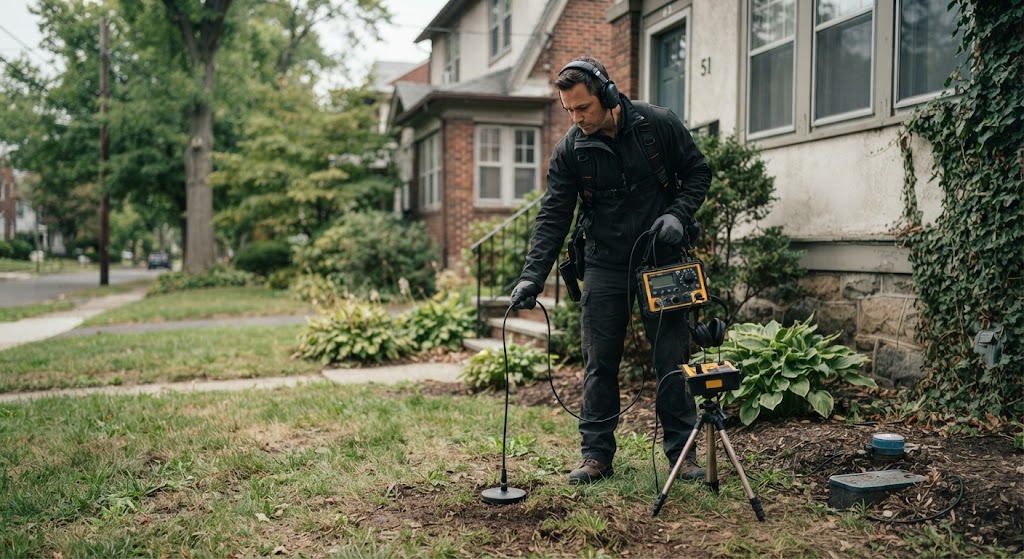
- Electromagnetic Utility Line Tracing: We apply an active radio-frequency transmitter to the service line at the interior shut-off, tracing the exact path and depth of the buried pipe from the foundation out to the street curb stop.
- Acoustic Subsurface Frequency Profiling: Escaping pressurized water generates a distinct acoustic vibration in the surrounding soil. Using high-sensitivity ground microphones with digital noise filters, we listen through soil, turf, and asphalt to pinpoint the peak acoustic amplitude.
- Differential Pressure Logging: We isolate the service line between the curb stop and the interior meter to calculate the precise rate of pressure loss, confirming leak size and hydraulic severity.
- Non-Toxic Tracer Gas Injection (When Needed): For deep lines or sandy backfill where acoustic signals dissipate, an environmentally safe helium-nitrogen gas mixture is introduced into the depressurized line. Sensitive sniffer probes detect tracer gas molecules as they rise through the soil.
What Happens After Detection: Trenchless and Excavation Options
Once our technicians mark the exact surface coordinates and depth of the leak, property owners can choose the most efficient repair method:
Targeted Surgical Excavation: If the pipe is modern copper and the breach is isolated, a small two-by-two-foot hole can be dug directly over the marked point, allowing a licensed plumber to install a flared or brazed repair sleeve. Remember: Call NJ One Call (811) before any digging to verify that gas, electrical, and telecommunications cables are clearly marked.
Trenchless Pipe Pulling / Directional Boring: If the service line is aging galvanized steel or lead, trenchless replacement pulls a new seamless copper or polyethylene pipe directly through the old line without tearing up your landscaping or driveway. For related subterranean drainage checks, explore our sewer line leak detection capabilities.
Cost Factors in Underground Water Line Diagnostics
Investment in underground leak pinpointing depends on property-specific characteristics:
- Length of the Service Lateral: Expansive properties in Upper Montclair with long setback distances from the road require broader acoustic profiling than compact urban lots in Montclair Center.
- Surface Coverings: Lines passing beneath concrete driveways, flagstone terraces, or thick asphalt require specialized hard-surface contact microphones.
- Soil Composition & Depth: Deeply buried lines in heavy clay or rocky basalt soil may require tracer gas deployment if acoustic vibrations are damped by dense backfill.
- Curb Stop Accessibility: Older curb boxes that are buried or seized require mechanical clearance to achieve complete pressure isolation.
Preventing Subsurface Service Line Failures
Take proactive steps to safeguard your exterior water service infrastructure:
- Avoid planting deep-rooted trees or large ornamental shrubs directly over your water service line easement.
- Ensure the municipal curb shut-off box remains visible and level with your lawn, never buried beneath garden mulch or paving stones.
- Investigate sudden drops in household water pressure promptly; an early-stage service line fissure can erode soil and compromise foundation footings.
- Confirm with the Montclair Water Bureau whether your property's service line contains legacy lead or galvanized piping slated for municipal replacement.
When Is a Water Line Leak an Emergency?
While a slow ground weep allows for planned scheduling, sudden sinkholes, pavement undermining, or water pushing through your basement foundation wall constitute urgent hazards. If pressurized water is threatening structural foundations or eroding soil near electrical service conduits, shut off the curb valve if possible and consult our emergency leak repair team immediately.
Montclair Areas with Frequent Water Line Issues
Underground service line problems are common in properties with historic infrastructure. Along Bloomfield Avenue and the South End, aging supply lines frequently experience stress from heavy vehicular traffic vibrations. In Upper Montclair and areas near Brookdale Park, rocky hillside terrain and mature century-old trees frequently create soil shifts that shear aging service lines.
Frequently Asked Questions About Water Line Leak Detection
Where is the property owner responsible for a leaking water service line in Montclair?
In Montclair, the property owner is generally responsible for the water service line from the curb stop shut-off valve at the property boundary into the home, while the municipal utility maintains the street main up to the curb stop.
How do you detect an underground water line leak under a lawn without trenching?
We deploy electro-acoustic ground microphones and helium or nitrogen tracer gas testing. Escaping pressurized water creates specific acoustic vibrations, and tracer gas injected into the line percolates upward through soil to surface sensors, pinpointing the leak location accurately.
Does New Jersey have a lead service line replacement mandate?
Yes. New Jersey requires water utilities to inventory and replace lead and galvanized service lines within ten years under statewide legislation. If your service line is compromised, replacement often qualifies under utility compliance initiatives.
Is calling 811 mandatory before digging to repair a water service line?
Yes. Call NJ One Call (811) before any digging to mark buried electric, gas, and telecommunications utilities, ensuring safe excavation and avoiding legal penalties.
Pinpoint Your Water Service Line Leak Today
Preserve your lawn and driveway with non-invasive acoustic detection. Call our local Montclair team now.